Best Practices for Dust, Noise, and Vibration Control in Occupied Buildings
Executing construction work in an occupied building requires a higher level of planning, coordination, and care. The following best practices help minimize disruption, protect occupants, and maintain a professional environment throughout the project.
Garichel Sosa
2/4/20262 min read
1. Hard Temporary Partitions
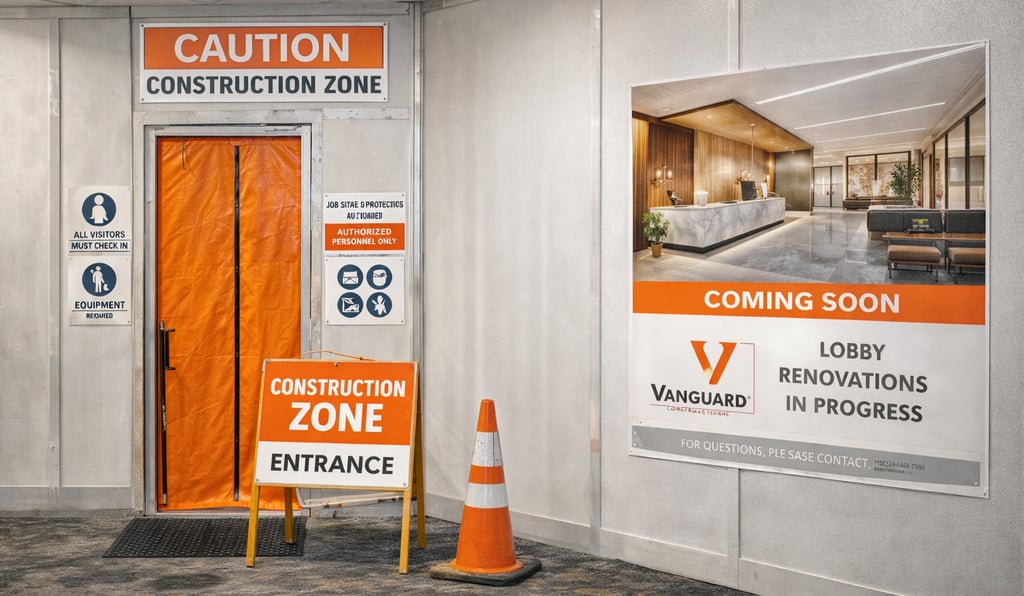
Construct hard temporary partitions to fully separate the construction zone from occupied areas. These partitions provide superior dust, noise, and visual control compared to plastic barriers and are the preferred solution for long-duration or high-impact work.
2. Magnetic Zippered Access Doors
Where permanent temporary doors are not feasible, use magnetic zippered access doors. These allow workers to enter and exit efficiently without repeatedly opening and closing traditional zippered enclosures, reducing dust migration.
3. Sticky Mats at All Exits
Install sticky mats at every exit from the construction zone to capture dust and debris from footwear and carts. Mats should be inspected frequently and replaced 2–3 times per day, or more often as conditions require.
4. Negative Air Machines with HEPA Filtration
Deploy negative air machines equipped with HEPA filters to maintain negative pressure within the construction area. Exhaust filtered air directly to the exterior—never into the building’s HVAC system or adjacent spaces.
Establish a clear airflow path for dust to exit the building
Run machines continuously, including after hours
Inspect and maintain filters daily
Turning machines off too early defeats the purpose and increases the risk of dust migration.
5. Schedule Loud Work Outside Normal Business Hours
Whenever possible, plan demolition, coring, and other high-noise activities outside normal business hours to reduce disruption to occupants.
6. Designate Separate Construction-Only Paths
Establish dedicated routes for construction personnel, materials, and debris that are isolated from tenant circulation paths. This improves safety, cleanliness, and overall building operations.
7. Protect Common Area Floors, Walls, and Elevators
Protect all shared spaces with rated protection systems appropriate for the duration and intensity of the work:
Use multiple layers of Ram Board and Masonite for floor protection
Install corner guards at all wall corners and door jambs
Protect elevators with custom elevator pads, and use Masonite or plywood with non-slip surfaces to protect elevator floors as needed
8. Communicate Upcoming Loud or Disruptive Work
Noise complaints typically stem from surprise, not volume. Proactive communication—such as advance notices and weekly look-aheads—sets expectations and builds trust with occupants and property management.
9. Install Clear and Professional Signage
Post clear signage identifying construction zones, access restrictions, and anticipated durations. Well-designed signage reinforces safety while projecting professionalism.
10. Maintain Rigorous Daily Cleaning
Perform daily cleaning of the construction site and adjacent areas. A clean site reduces dust migration, improves safety, and demonstrates respect for the occupied environment.
Contact
2727 Paces Ferry Road SE Suite 750 Atlanta, GA 30339
678-827-5557
© 2026 Vanguard Construction Company LLC. All rights reserved.
Follow Us