Tips for Awarding Mechanical Scope of Work
Mechanical scopes are among the most complex and risk-heavy packages on a project. From HVAC controls to exhaust systems and commissioning, small scope gaps can quickly turn into large change orders, schedule delays, and finger-pointing between trades. Here are key areas every General Contractor should tighten up before awarding a mechanical contract.
Garichel Sosa
2/14/20262 min read
1. HVAC Controls – Define the Responsibility Clearly
Confirm the exact controls package being purchased (Johnson, Siemens, Honeywell, etc.)
Confirm electrician has all conduit requirements.
Confirm electrician has all transformers required if they are not included with the HVAC controls.
Confirm integration requirements with existing Building Automation Systems (BAS).
Owner training and post-occupancy support.
Confirm who is responsible for providing network drops and IT coordination if controls tie into an owner’s enterprise system.
2. Electrical Circuits - Mechanical equipment is only as good as the power feeding it. Misalignment between mechanical and electrical scopes is a common source of change orders.
Confirm electrical contractor has circuits for HVAC equipment.
Confirm who is furnishing and installing disconnects, starters, VFDs, and motor protection are clearly assigned.
Confirm interlocks between fire alarm and HVAC shutdown are defined.
Pro Tip: Require a coordinated equipment schedule showing voltage, phase, MCA, and MOCP for every piece of equipment prior to award.
3. Commissioning – Many teams assume commissioning simply means TAB (Test and Balance). On higher-end or institutional projects, that assumption can cost six figures. If the project is healthcare or mission-critical, commissioning may require multiple site visits and extended documentation. Confirm:
Whether third-party commissioning is required.
Functional performance testing requirements.
Pre-functional checklists.
Owner training documentation.
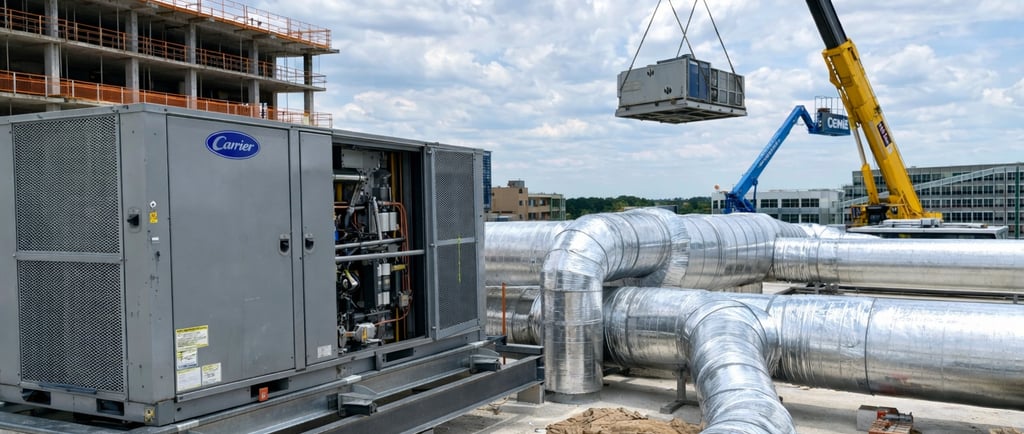
4. Factory-Installed Accessories – Mechanical equipment often comes with optional factory-installed components. Clarify in writing who is providing the following accessories:
Variable Frequency Drives (VFDs) – factory installed or field supplied?
Control boards and sensors.
Economizers.
Dampers and actuators.
Seismic restraints.
Roof curbs.
Smoke detectors at units.
5. Exhaust Systems – Exhaust scope is frequently incomplete in bid documents. Confirm inclusion of:
Kitchen hood exhaust systems.
Bathroom exhaust fans.
Dryer vents.
Fireplace venting.
Trash chute exhaust systems.
Elevator shaft pressurization (if required).
Parking garage exhaust and CO monitoring.
6. Insulation - Confirm the contract documents clearly identify all insulation requirements and that your HVAC contractor has them. Mechanical scope should clearly define:
Duct insulation (thickness and type).
Pipe insulation.
Condensation protection.
Vapor barriers.
Heat tracing (if applicable).
7. Temporary Conditions - Confirm if any of the following temporary conditions are needed that they HVAC contractor has them:
Temporary heating or cooling.
Temporary exhaust.
Dehumidification.
Temporary filters for air handlers during construction
Final Thought
Awarding mechanical scope is not just about price — it’s about clarity. The best way to protect your project is to:
Level bids line-by-line.
Issue detailed scope sheets.
Hold pre-award interviews.
Require written clarifications.
Mechanical systems are the heartbeat of any building. If you define the scope properly upfront, you reduce risk, protect margin, and deliver a smoother turnover to the client.
Contact
2727 Paces Ferry Road SE Suite 750 Atlanta, GA 30339
678-827-5557
© 2026 Vanguard Construction Company LLC. All rights reserved.
Follow Us